
 How a boyhood fascination with the smell of cut grass became a life spent shaping two of Asia’s most celebrated golf courses.
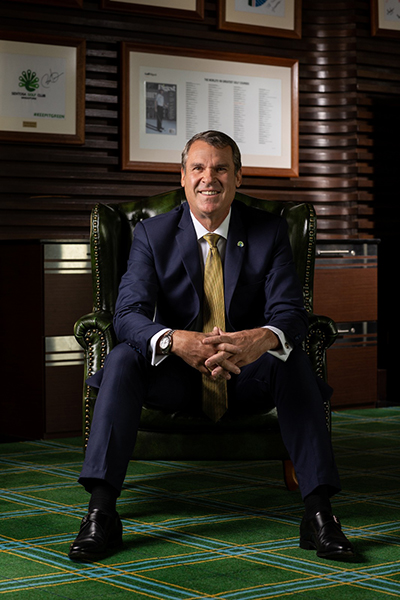
Long before Andy Johnston became General Manager, Director of Agronomy and resident course designer at Sentosa Golf Club, he was a boy wandering around The Broadmoor in Colorado Springs.
At first, it was the golfers who caught his eye. Their hats, shoes and clothes seemed to belong to a different world. But once he stepped onto the property, something deeper took hold. The staff always had a hello and a smile. The birds, butterflies and squirrels made the course feel alive. And everywhere he looked, someone had cared about the smallest detail.
“I remember the smell of the freshly cut grass and seeing those tightly defined lines where the greens met the collars,” he says. “Everything had a purpose. Everything was cared for.”
The young Johnston began asking questions. Who created this environment? Who looked after it? And how could he become part of it?
That curiosity never left. Today, he still sees more than tees, fairways and greens. He sees the people behind them, the wildlife around them, the way a bunker edge changes a view and the countless morning decisions that shape a golfer’s day.
It is a way of looking at golf that has come to define Sentosa.
That early fascination became a career combining architecture, construction and turf. Johnston studied architecture and turfgrass science before spending about a decade within the network of companies supporting the Arnold Palmer design team. He worked with Golf Course Consultants Inc., the construction team under the Palmer group, and at 25 was sent to Australia to manage construction of the Palmer course at Sanctuary Cove. He later moved further into agronomy and joined Gene Bates as Vice President of Design. By the time Singapore called, he had learned to see a course as its designer, builder and caretaker, the combination Sentosa would come to depend on.
A Promise That Changed Everything
Johnston first arrived in Singapore in 2005. He stayed at the Beaufort Hotel, just across the parking lot from Sentosa Golf Club, and initially saw the assignment for what it was: an exciting course redesign for an impressive new client.
During the negotiations, however, the club’s captain at the time, Bob Tan, made one condition clear. He did not want a design team that would finish the work and disappear. If Johnston took on the project, Tan expected him to return for the club’s major events and remain involved.
Johnston gave him his word.
“I made Bob a promise that I would stay connected,” he recalls. “Looking back, that conversation probably changed everything.”
He kept coming back. The visits became longer, the relationships grew closer and Sentosa gradually stopped feeling like a client. By 2010, Johnston could see a different future: a full-time role and the chance to help shape not only the golf courses, but the direction of the club itself.
There was no single dramatic moment when he decided Sentosa would become such a large part of his life. It happened slowly, built on trust and one promise kept over many years.
Three Hats, One Golf Course
Johnston now carries three substantial titles, but there is no doubt which version of him arrives at work first.
“The Director of Agronomy arrives first, without question,” he says. “The course is the product. It’s what people come to experience, and its quality must be delivered every single day.”
For Johnston, agronomy is a craft. A course is a living environment, especially in Singapore’s equatorial heat, humidity and rainfall. A decision made early in the morning can affect every golfer who plays that day.
Once the course is taken care of, the General Manager turns his attention to the team, the members and the wider operation. The designer arrives last, although Johnston admits that he never really leaves. He is always noticing a line, an angle, a bunker edge or a view that might be improved.
He sums up the relationship neatly: “The agronomist sees what the course needs today, the GM thinks about what the club needs tomorrow, and the designer is always looking for what the course could become.”
Two Courses With Very Different Personalities
Visitors with enough time should play both of Sentosa’s courses. Johnston is firm on that point. The Serapong and The Tanjong may share the same club, but they speak to golfers in very different ways.
“The Serapong is a monster,” he says. It is long, demanding and visually busy, with strong bunkering, tight lines and a succession of shots that ask a golfer to make a decision. It has a habit of inviting confidence and then exposing overconfidence.
Yet golfers rarely leave feeling beaten. They want another chance.
“The Serapong looks you in the eye and says, ‘Show me your best.’ The Tanjong puts its arm around you and says, ‘Come on, let’s have some fun.'”
The Tanjong feels more open and welcoming, with fewer bunkers and high, rounded sand lines influenced by the style of Alister MacKenzie. It is still strategic, but it presents its challenge with a lighter touch.
Johnston’s favorite details reveal how closely he reads both courses. On The Tanjong, the par-three fourth has a creek running toward a green edged by juniper, white fountain grass and spartina. The 18th has sculpted bunkers, a recently added fairway trap and a great banyan ficus tree that he says looks as though it belongs in a Harry Potter film.
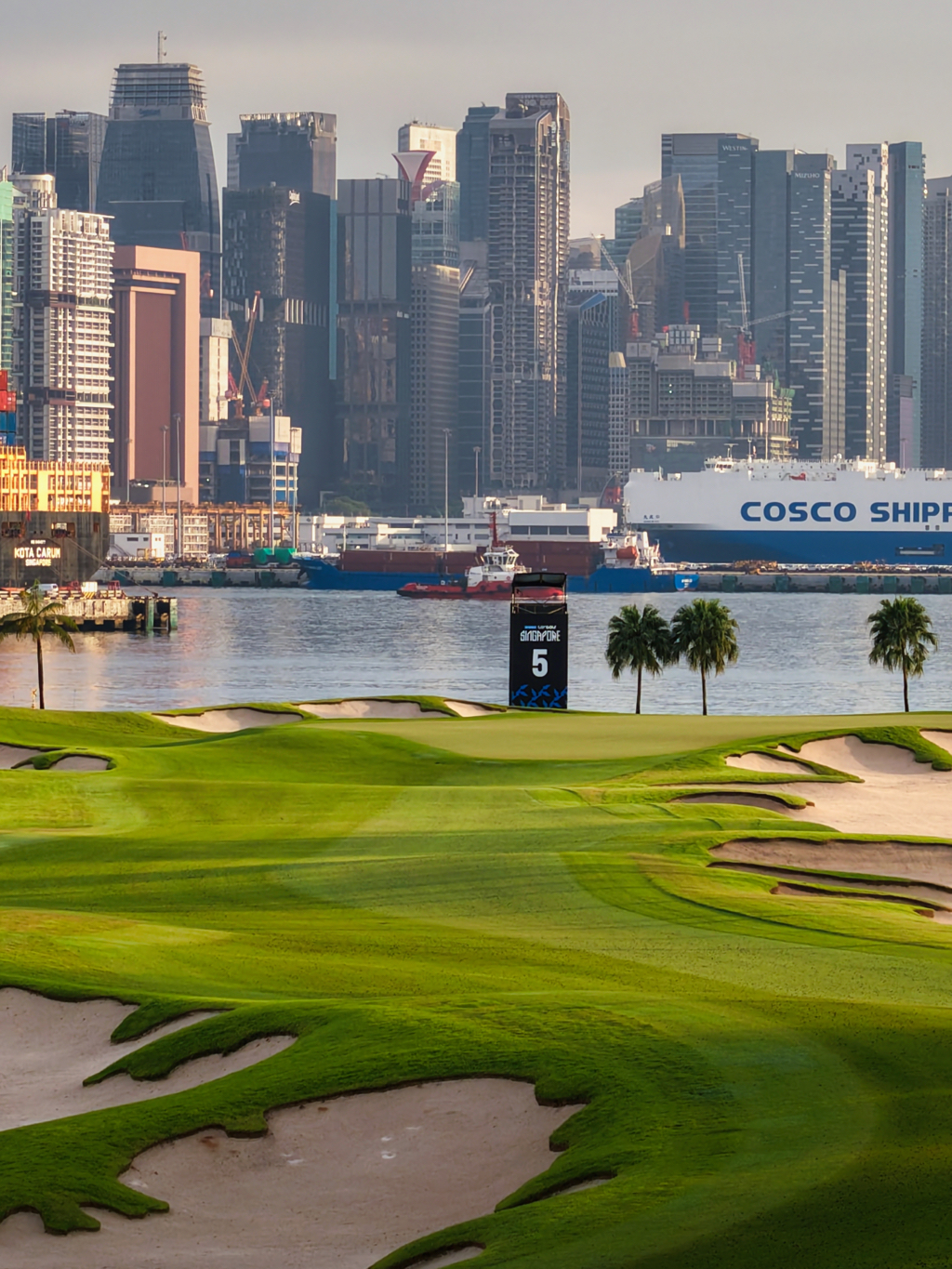
On The Serapong, the fifth is famous for its view toward Singapore’s skyline. But the par-five fourth holds particular interest for its double landing area, risk-and-reward choices and serpentine wall following the lagoon.
Across the course, Johnston also uses horizon lines to disguise space. A golfer may stand over a shot convinced there is nowhere safe to land, even when the room is there.
“Golf should engage your mind as much as your eye,” he says. “The best holes don’t just tell you where to hit the ball. They create a little doubt.”
You Do Not Have to Accept Every Challenge
For golfers who have watched professionals take on The Serapong, the prospect of playing it can be intimidating. Johnston does not pretend otherwise.
“The Serapong is scary. There’s no getting around that.”
His advice is to resist the dares. Play toward the landing areas, put the ball in position and avoid the bunkers. The heroic route may look appealing, but an everyday golfer will usually have more fun by choosing the sensible shot.
The same patience is needed on the greens. They are fast, and much of their movement is subtle. A putt that looks straightforward may have more happening than first appears.
“Serapong will tempt you all day long,” he says. “You don’t have to say yes every time.”
Where Tournament History Stays Behind
Sentosa welcomed three major events in 2026, with the HSBC Women’s World Championship on The Tanjong and LIV Golf Singapore and the Singapore Open on The Serapong.
When the grandstands and ropes come down, the history remains. Plaques around the courses mark the places where memorable moments happened. A visiting golfer can stand where Michelle Wie made her winning putt or find reminders of shots played by Adam Scott, Brooks Koepka and Sergio Garcia.
The effect of tournament golf goes beyond those markers. Every event teaches the Sentosa team more about firmness, green speed, sightlines, presentation and course setup. Those lessons become part of the everyday experience, long after the cameras have left.
The greens are a good example. Johnston says the team aims for an average speed of around 10.5 throughout the year, comparable to the annual average on the DP World Tour. Maintaining that consistency on the equator takes constant measurement and adjustment.
Most golfers will never see the work. They will simply feel that the greens are pure and the course looks right. To Johnston, that is the compliment.
“The tournament standard isn’t something we switch on for one week,” he says. “It’s the standard we chase every day.”
Sustainability You Can See Working
Ask Johnston for a sustainability tour and he begins at the top of the Pyramid, where eight of Sentosa’s 40 stingless-bee hives are located. What started as a modest project has become one of the club’s favorite success stories and a natural way to talk with visitors about pollinators and biodiversity.
From there, he would point toward the lakes. They are part of the courses’ beauty and strategy, but they also collect the rainwater used for irrigation.
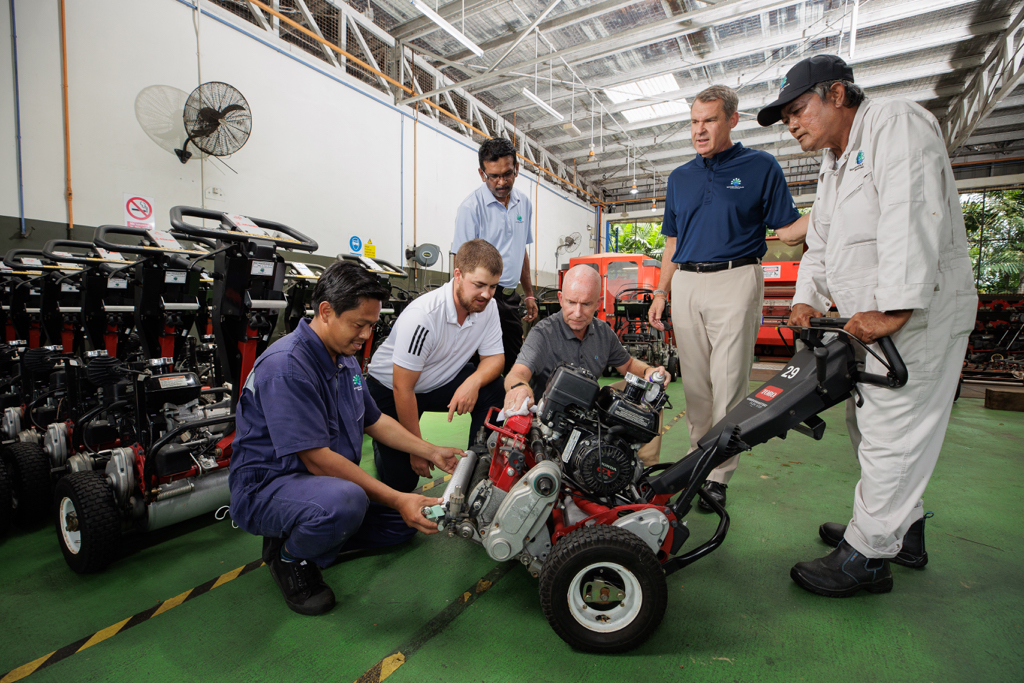
The tour would continue behind the scenes. Sensors beneath the greens report soil temperature, salinity and moisture. Biochar helps improve the soil and reduce other inputs. Electric and autonomous machinery is becoming part of the maintenance operation. Two biodigesters process food and horticultural waste so the resulting material can be reused on the property instead of going to landfill.
“Sustainability at Sentosa isn’t something sitting in a report or a sign beside the first tee,” Johnston says. “You can see it, touch it and watch it working.”
Nature appears in places even he did not expect. Kingfishers and parrots cross the course, squirrels are everywhere and healthy families of otters move around the property. Just offshore, Johnston says coral is developing beside one of the world’s busiest ports.
For him, these are signs that a highly maintained golf course and a sensitive natural environment do not have to exist in conflict.
Stop and Stay in Singapore
Johnston believes international golfers often underestimate Singapore. His ideal Sentosa day begins with breakfast at the club, followed by an early tee time while the course is waking up. The birds and wildlife are active, and views of the city, port and sea appear between the holes.
After golf, a visitor can have lunch at the club and be on the beach soon afterward. The cable car, hotels, restaurants and island attractions make Sentosa easy to enjoy with non-playing partners and family members. Singapore’s dining and nightlife are close enough to round out the evening without losing hours in transit.
His advice is simple: do not treat Singapore as somewhere to pass through.
“I’d stop and stay,” he says. “Give us a few days, play both golf courses and experience the island. I think you’ll leave wondering why you didn’t do it sooner.”
At the Golfers’ Terrace, Johnston recommends letting Chef KK choose one of his local specialties. His own post-round order is rather less elaborate: avocado and two hard-boiled eggs.
Still Curious After All These Years
Nearly two decades after his first visit, Johnston still wakes up eager to see the property. He wants to know what changed overnight, what looks better and what needs attention.
“There is something about these courses that touches my soul in places I can’t completely explain,” he says.
He has watched the courses change and mature, shaping them with his own hands and ideas. In return, he feels they have shaped him. But he never considers them finished. Golf courses are living things, a little different every day.
The people have become just as important. The team, members and visiting golfers have taught him that looking after Sentosa means caring for a place that carries meaning for others.
For a first-time visitor, he hopes the memories go beyond the conditioning, skyline and scorecard. He wants them to remember the warmth of the welcome, the wildlife, the smell of the grass and the feeling that there was something different about the place.
It is the same feeling that captured him as a boy at The Broadmoor and brought him back to Sentosa, morning after morning.
“Play golf in Singapore because it’s like no other place on earth,” he says. “It will touch your soul, and it may never let you go.”
Experience both sides of Sentosa as part of a tailor-made Singapore golf holiday. Golfasian can arrange confirmed tee times on The Serapong and The Tanjong, selected hotels, private transfers and time to enjoy Singapore beyond the golf course. Contact our team to plan your trip.